
What Is Peer Pressure and How It Works
There is a moment most people can recall — standing at a crossroads between what they know is right for them and what the people around them are doing or expecting. Maybe it was being offered a cigarette at a party and feeling the weight of a dozen eyes watching for your response. Maybe it was going along with a group decision you privately disagreed with, afraid that speaking up would cost you your place in the circle. Maybe it was something smaller — laughing at a joke you didn't find funny, buying something you didn't need, or staying out later than you intended because no one else was leaving.
These moments, in all their variety, are the lived experience of peer pressure. It is one of the most universal aspects of human social life, one that begins in childhood and never entirely disappears, even in adulthood. Yet despite how familiar it feels, peer pressure is frequently misunderstood — reduced to a simple narrative of bad friends leading good kids astray, when the reality is far more nuanced, far more psychological, and far more deeply woven into the fabric of how human beings relate to one another.
Defining Peer Pressure
Peer pressure refers to the influence that people within the same social group exert on one another — consciously or unconsciously — to conform to certain behaviors, attitudes, values, or choices. The word "peers" typically refers to people of a similar age, background, or social standing, though the principle extends to any group whose membership a person values and whose approval they seek.
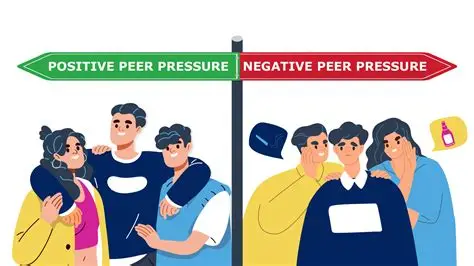
It is important to understand from the outset that peer pressure is not inherently negative. The same social force that pushes a teenager toward risky behavior can also push them toward studying harder, volunteering, or developing healthier habits. The direction of peer pressure depends entirely on the values and behaviors that the group normalizes. What makes peer pressure powerful — and sometimes dangerous — is not the force itself, but the context in which it operates and the degree to which an individual's sense of identity and belonging is tied to the group's approval.
Peer pressure operates on a spectrum. At one end is direct, explicit pressure — someone literally telling you to do something, daring you, or threatening social consequences if you refuse. At the other end is indirect, implicit pressure — the subtle sense that everyone around you is doing something, or expects you to do something, without anyone saying a word. Both forms are real, both are powerful, and the indirect form is often the more influential of the two precisely because it is harder to identify and resist.
The Psychology Behind It
To understand why peer pressure works, you have to understand something fundamental about human psychology: we are profoundly social creatures. The need to belong — to be accepted, valued, and included by a social group — is not a superficial desire. It is a deep, evolutionarily rooted drive that psychologist Abraham Maslow placed near the base of his famous hierarchy of needs, just above physical survival and safety.
For most of human history, being excluded from the group meant reduced access to resources, protection, and reproduction. Social rejection was not merely uncomfortable — it was genuinely dangerous. The brain evolved to treat social exclusion as a threat comparable to physical pain, which is why rejection activates some of the same neural pathways as physical injury. This biological reality means that the fear of being left out, judged, or ostracized is not weakness or vanity — it is a deeply wired human response with ancient evolutionary roots.
This is the foundation on which peer pressure operates. When we perceive that belonging to a valued group requires us to think, speak, or behave in certain ways, the pressure to comply comes not just from outside but from within — from the brain's own threat-detection system, which registers nonconformity as a form of social danger.
Psychologists identify several specific mechanisms through which peer pressure exerts its influence. Normative influence refers to the pressure to conform in order to gain acceptance and avoid rejection — doing what the group does not because you believe it is right but because you want to fit in. Informational influence refers to the tendency to look to others for guidance about how to behave, particularly in uncertain or ambiguous situations — assuming that if everyone around you is doing something, they must know something you don't. Both mechanisms operate largely below the level of conscious awareness, which is part of what makes peer pressure so effective and so difficult to resist through sheer willpower alone.
The Role of Identity and Self-Esteem
Not everyone is equally susceptible to peer pressure, and understanding why reveals something important about its inner workings. Research consistently shows that a person's vulnerability to peer pressure is closely tied to the strength and stability of their sense of identity and self-esteem.
People who have a well-developed, secure sense of who they are — what they value, what they believe, what kind of person they want to be — are better equipped to resist pressure that conflicts with that identity. They can decline without feeling that their entire social world is at risk, because their sense of self is not entirely dependent on the approval of any particular group.
By contrast, people with fragile or underdeveloped self-esteem, or those in the process of forming their identity — which describes most adolescents — are significantly more vulnerable. When your sense of self is still being constructed, the approval of peers functions almost like a mirror: you look to others to see who you are. Under these conditions, the threat of social rejection is not just uncomfortable — it feels existentially destabilizing. This is one of the reasons adolescence is the period of life most associated with peer pressure and its consequences, though it is far from the only stage in which it operates.
Adolescence: The Peak Vulnerability Window
There are good neurological reasons why teenagers are particularly susceptible to peer pressure, beyond just the psychological factors of identity formation. The adolescent brain is undergoing a profound developmental transformation, and the specific pattern of that transformation creates a window of heightened vulnerability to social influence.
The prefrontal cortex — the region of the brain responsible for impulse control, risk assessment, long-term planning, and the ability to resist immediate gratification in favor of future consequences — is the last part of the brain to fully mature. It does not reach full development until the mid-twenties. The limbic system, by contrast, which drives emotional responses, reward-seeking, and social sensitivity, matures much earlier and runs hot during adolescence.
This developmental mismatch means that teenagers feel the pull of social reward intensely but have limited neurological capacity to pump the brakes. Studies using brain imaging have shown that the presence of peers actually changes how the adolescent brain processes risk — activating reward centers in ways that make risky behaviors seem more appealing when observed by peers than when alone. The same teenager who makes a cautious decision in isolation may make a reckless one when friends are watching, not because they have forgotten the risks, but because the social reward of peer approval temporarily outweighs them in the brain's calculation.
This is not a character flaw. It is neuroscience. And it has important implications for how we think about adolescent behavior, parenting, education, and the environments we create for young people.
Forms of Peer Pressure
Peer pressure manifests in a wide range of forms, some obvious and some remarkably subtle. Understanding these different expressions helps in recognizing peer pressure when it arises — in oneself and in others.
Direct verbal pressure is the most recognizable form. This includes explicit encouragement, daring, taunting, or ultimatums — "Come on, just try it," "Don't be such a coward," or "If you don't do this, you're not really one of us." This kind of pressure is relatively easy to identify, though not always easy to resist, because the social stakes are made explicit.
Indirect social pressure operates through observation and implication rather than direct request. When everyone in a group is drinking, using drugs, engaging in risky behavior, or subscribing to a particular set of attitudes, the pressure to join in is real even if no one says a word. The behavior of the group itself communicates a norm, and deviation from that norm requires active, conscious effort.
Exclusionary pressure works through the threat of social rejection. This can be explicit — "You're not invited if you don't come along" — or implicit, expressed through cold shoulders, reduced inclusion, or subtle social signals that nonconformity has a price.
Online and social media pressure has emerged as one of the most powerful and pervasive contemporary forms. Platforms designed around likes, shares, follower counts, and public visibility have created environments where the social comparison and approval-seeking that drives peer pressure operate at massive scale and with relentless frequency. The pressure to present a certain image, participate in viral trends, express particular views, or accumulate social validation online can be as powerful as any in-person peer dynamic — and it follows people into spaces that were once private, including their bedrooms in the middle of the night.
Self-generated pressure — the internalized voice of the peer group — is perhaps the most insidious form of all. After prolonged exposure to a group's norms and expectations, people often begin to police themselves, anticipating how the group would react and adjusting behavior accordingly even in the group's absence. The external pressure has been absorbed and made internal, which is why breaking free from peer pressure is often as much an internal process as a social one.
Positive Peer Pressure
The conversation about peer pressure tends to focus almost exclusively on its negative manifestations, but the same social dynamics that can lead people toward harmful behavior can equally lead them toward positive choices. Positive peer pressure is real, powerful, and worth understanding and deliberately cultivating.
When a group normalizes academic effort, physical fitness, community service, creative ambition, or emotional honesty, the social influence of that group pushes its members toward those same values. A teenager whose friend group takes studying seriously is more likely to study. A person who joins a running club finds themselves training harder than they would alone. An employee in a workplace culture that values ethical behavior is more likely to make ethical choices under pressure.
Mentorship relationships, team sports, youth organizations, religious communities, and peer support groups all harness the power of positive peer influence deliberately. The science of social norms suggests that one of the most effective ways to change behavior — whether it is reducing alcohol consumption, increasing recycling, or improving academic performance — is to accurately communicate what the majority of peers are actually doing, because people consistently overestimate how common risky or antisocial behaviors are among their peers and underestimate how common positive ones are.
Understanding peer pressure as a neutral force — one that can be directed toward harm or health depending on context — opens up possibilities for using it constructively, rather than simply trying to defend against it.
The Consequences of Giving In
When peer pressure leads people toward harmful choices, the consequences can range from minor to severe and life-altering. Among adolescents, the behaviors most commonly associated with negative peer pressure include substance use — alcohol, tobacco, cannabis, and harder drugs — risky sexual behavior, reckless driving, bullying, academic dishonesty, and engagement in criminal activity.
The consequences of these choices ripple outward in multiple directions. In the short term, they can involve accidents, injuries, legal trouble, academic failure, damaged relationships, and health complications. In the longer term, early substance use in particular carries significant risks — adolescent brains are more vulnerable to the addictive properties of substances, and early initiation is one of the strongest predictors of substance use disorders in adulthood.
Beyond specific behavioral risks, the habit of consistently yielding to peer pressure carries its own psychological cost. People who routinely suppress their own values, preferences, and judgment in order to conform gradually lose touch with their authentic sense of self. They become experts at reading and responding to what others want, and strangers to their own inner voice. This erosion of authenticity is associated with increased anxiety, depression, diminished self-esteem, and a pervasive sense of emptiness that is difficult to name but impossible to ignore.
Resisting Peer Pressure: Building Inner Resources
Resisting peer pressure is not primarily a matter of knowing the right words to say, though having prepared responses can help. At a deeper level, it is about developing the inner resources — self-awareness, self-esteem, values clarity, and emotional regulation — that make genuine resistance possible.
Self-knowledge is the foundation. People who have a clear, internalized sense of their own values and identity have a stable reference point from which to evaluate pressure. When someone asks them to do something that conflicts with who they are and what they believe, the conflict is felt immediately and clearly, rather than being muddied by uncertainty about what they want in the first place.
Genuine self-esteem — not the performance of confidence but the actual felt sense that one's worth is not contingent on the approval of any particular group — reduces the threat value of social rejection. When belonging to a specific group is not the foundation of one's entire identity, the prospect of disappointing that group becomes manageable rather than catastrophic.
Assertiveness skills — the ability to say no clearly, calmly, and without excessive apology or explanation — are practical tools that can be learned and practiced. "No thanks, that's not for me" said with quiet confidence is often more effective than an elaborate justification, which invites debate and signals uncertainty.
Choosing peer groups deliberately — seeking out people whose values, interests, and character align with one's own — is one of the most powerful long-term strategies available. You cannot entirely choose who you encounter in life, but you can invest more deeply in relationships with people who bring out the best in you rather than pressure you toward choices you will regret.
The Role of Parents, Educators, and Communities
Helping young people navigate peer pressure is not a task that falls on individuals alone. Parents, educators, and communities all play essential roles in building the environments and relationships that give young people the best chance of making choices that serve their genuine well-being.
Parents who maintain open, honest, non-judgmental communication with their children create the conditions under which those children are more likely to seek guidance when facing difficult social situations. The research is clear that adolescents who feel genuinely connected to their parents — not just supervised by them — are significantly less susceptible to negative peer influence. Connection is more protective than control.
Educators can address peer pressure directly through social-emotional learning curricula that help young people develop self-awareness, empathy, assertiveness, and critical thinking skills. Creating classroom and school cultures where diversity of opinion is valued, where kindness is modeled and expected, and where authentic individuality is celebrated rather than punished reduces the social pressure to conform to harmful norms.
Communities that provide young people with meaningful opportunities — in the arts, in sports, in service, in leadership — give them contexts in which to develop identity, competence, and belonging in healthy ways, reducing the degree to which any single peer group holds total sway over their sense of self.
Peer Pressure in Adulthood
It would be a mistake to conclude that peer pressure is exclusively a young person's problem. Adults face peer pressure constantly — it simply tends to be more subtle and more socially sanctioned than the adolescent variety.
The pressure to keep up with neighbors' lifestyles, to conform to workplace cultures that may conflict with one's values, to drink at social events because everyone else is, to hold certain political views within one's social or professional circle, to parent in particular ways, to achieve certain financial or status markers — all of these are forms of adult peer pressure operating through the same basic psychological mechanisms as their adolescent counterparts.
Adult peer pressure is often harder to recognize because it is so thoroughly normalized. The social norms of adulthood are embedded in culture, institutions, and everyday expectations in ways that make nonconformity feel eccentric or antisocial rather than simply different. Recognizing this — naming it honestly as the social pressure it is — is the first step toward making genuinely autonomous choices rather than choices driven by an invisible script written by the group.
Conclusion
Peer pressure is not a simple phenomenon with a simple solution. It is woven into the deepest layers of human psychology, rooted in our most fundamental need to belong, shaped by the neuroscience of the developing brain, and expressed in forms ranging from the obvious to the nearly invisible. It is neither purely negative nor purely positive — it is a social force, and like all forces, its consequences depend on the direction in which it is applied.
Understanding peer pressure — how it works, why it is so powerful, and what shapes our vulnerability to it — is not just an academic exercise. It is a form of self-knowledge that empowers more conscious, intentional living. When we can see the social currents that move us, we are better positioned to choose which ones to swim with and which ones to resist.
The goal is not to become an island — disconnected from community, indifferent to belonging, immune to the influence of others. Human beings need each other, and the social bonds that create healthy peer influence are among the most valuable things in a person's life. The goal is to remain, within those bonds, genuinely and authentically oneself — capable of belonging without losing the thread back to your own values, your own judgment, and your own voice.
That balance — between connection and autonomy, between belonging and integrity — is one of the great ongoing challenges of human life. And understanding peer pressure is a meaningful step toward meeting it with greater wisdom and grace.